
Downtime downward dogs - with Climb+Yoga founder, Sandra Berlin
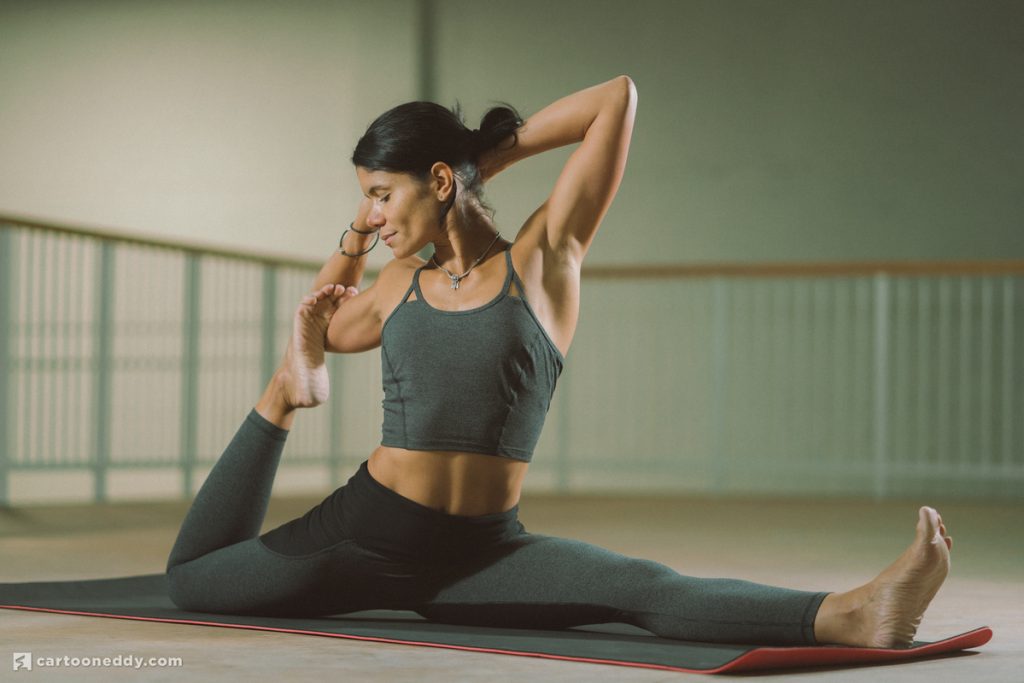
Sandra is a climbing coach and yoga teacher who has been working in these fields for over 10 years. She is also the founder of Climb & Yoga Ltd where, along with her team, she delivers classes, workshops and retreats specially designed for the needs of climbers (of all ages and abilities). Climb & Yoga are committed to helping climbers and other sports folk discover the benefits of how yoga practice can support and improve their performance. Promoting healthy mobility/flexibility, strength, balance and body awareness, their yoga classes are devoted to correct alignment and technique which will, in turn, assist with better injury avoidance. There is also a keen focus on mindfulness via exercises that enhance concentration and harmony between mind and body, thus helping to improve the head-game too. Sandra is also a full-time mum and has very kindly taken time out of her busy schedule of homeschooling, online yoga classes and her own daily practice to talk a bit about how yoga can help not only with climbing, but with calming the mind during periods of anxiety, even if it's just fitting a few simple moves into your day.
Some people aren't really sure what to make of yoga and it can get a bit of a bad rap. Can you explain what yoga is and which style you have come to favour and why?
Yoga is a full body practice and, contrary to what many might think, is more about strength than unrealistic gymnastic shapes! When I say strength I don't must mean physical. Yoga is a powerful tool to help us understand ourselves both physically and mentally, and, in return, this will assist us with the way we relate to others and to whatever environment we find ourselves in at any given time. This can range from how to learn to develop qualities such as compassion, to simply how we move across uneven terrain (proprioception skills). When it comes to the more ancient beliefs regarding it... effectively, yoga gives you superpowers!
Through meditation, you give yourself time to sit with your thoughts, feelings and worries, learning to take a step back, to distance yourself from them, and occupy your mind with being present, without giving too much attention to what has happened or is about to happen. There are many different styles out there and that can be a bit confusing but essentially it is about taking time to connect to mind and body.
Through Asana practice (the actual physical part of yoga), you move your body in ways you don’t usually do during your day-to-day activities. Through this physical activity, yes, you build-up strength and mobility, but you also develop resilience and concentration skills. Have you seen people’s faces when trying to hold Warrior 2 in a class?
You often see people at the climbing gym bashing-out a couple of downward dogs and a few eagles at the end of a session but how exactly does yoga complement climbing? I mean... it's more than just stretching tight muscles, right?
Yes these are useful “stretches” for climbers (stretching out the back and shoulders) but, during a good yoga practice, separate from your climbing session, you access muscles and tissues you probably don’t use regularly (climbers often tend to rely heavily on a few muscle groups) and will be exercising antagonistic muscles in your body, as well as working on keeping your joints healthy and mobile. It is also about getting to know yourself better, physically and mentally, and learning how your body can (should) move which can be a really useful tool when it comes to helping to spot early signs of injuries, or when and why you might not be trying hard enough.
Which came first for you, climbing or yoga? And why did you become an instructor?
I have been practising yoga for many years, even before climbing took over my life 13 years' ago. But I only came to realise its true benefits after a long and testing period of injuries and operations. I found myself unable to do the sport I loved so much (climbing) and was stuck at home, feeling not only physically but mentally crippled. I always knew yoga was a great tool for climbing and had decided to join my yoga studio Teacher Training (just before I got injured) in order to enhance my skills-set to better assist my Climbing clients. That period of recovery brought me closer to yoga, waking me up to the realisation of how truly special this relationship is.
Let's talk a bit more in depth about the mental benefits. How exactly did yoga help you get through the more testing times?
Through meditation and mindfulness practice I learned to quieten the noisy chatter in my head; the thoughts of, “if only I hadn't got on that climb...”, or “I’ll never recover from this”, “I won’t climb as well as before” etc. etc. I learned to focus more on the present and on recovery and training. I learned to cultivate a more positive attitude towards life and a more pro-active attitude of getting on with the job rather than crying on my bed feeling sorry for myself.
Yoga also teaches you compassion towards yourself and others, hence I learned to be kinder to myself and stopped asking so much of myself. Although it’s easier said than done, nowadays I am more relaxed in the knowledge that I am enough .
How do you think that yoga practice can help people in these uncertain times? A lot of folk will be worrying that without their regular climbing they will stiffen-up/"get weak" etc., but let's also consider the mental benefits in terms of the anxiety levels that will be rising because people can't climb and are worried that when they will be able to again they will be de-conditioned. How yoga can help not just with keeping muscles strong but also with the tension that that anxiety about their climbing might bring?
We teach yoga exercises that promote flexibility and strength, but yoga is no substitute for specific training for your sport. For example, I still use fingerboards and weights etc. However, yoga is the perfect complement to this more specific training for the aforementioned reasons.
But the head side is just as important and starting a meditation practice will bring many benefits during these difficult times. There are a number of apps now available. Headspace being my favourite (they have a free plan too). At Climb & Yoga we are offering a free, live, guided meditation session on Thursday mornings too.
Some people may find it hard to get started, but it doesn’t require much really. A quiet space, 5-10 minutes to sit or lie down still, is all you need. Even if you just start with focussing on a few deep breaths. Try to get into a routine, find the optimal time in your day and stick to it. Put it in your diary, create an alert on your phone etc.
You mention deep breaths; on a day to day basis most people only access a small amount of their potential lung capacity. Why is the breath such a key part of the practice?
It’s well known between yoga practitioners that “the breath is the gateway to the mind”. Steady breathing leads to a steady mind.
It's true most of us don't really access our full capacity and it can be a game-changer. It's fairly simple to increase this and tune-in to how your ribs and diaphragm move when you breathe. If you breathe in for 4 seconds, pause briefly, then breathe out for 6 seconds and repeat this, say, 10 times, once a day, you will soon see that you will be able to increase the counts and you will be more in-tune with your breath. It's also a good way to take 5 and focus on something else.
Can you also explain how it can help you in climbing, general fitness (developing better lung capacity) and indeed just helping you tune in and calm down during those times when you are bricking-it because you are about to take a whipper. Some climbers also use yogic breathing for focus before setting off on a climb (like the "skull shining breath" technique). How does breathing help with the more mental side of climbing?
What happens when you take a deep breath during a challenging time? Try it for yourself, observe what happens to your body when you are angry or frightened? Your heart rate and blood pressure rise, your breath shortens, you feel exhausted. The opposite occurs when you are relaxed. This is what happens when our Sympathetic (fight or flight) and Parasympathetic (rest and digestive) nervous systems are activated. Obviously, we need both sides of the coin in order to survive in this world, but when stressed our Sympathetic system is activated, and when always stressed it will take over, leaving you open to all sorts of problems including heart disease and high blood pressure.
Translating this into climbing, and, for example Sport Climbing, we need the Sympathetic system in order to spring into action, but then we also need (especially on steep routes) to find rest in order to recover and carry on. At this point we need to trigger the Parasympathetic system, and how do you do that? By steadying your breath. How do you steady your breath? Try to prolong your exhalations and see the magic happening. Your breath will slow down and you will recover more quickly ready to resume action.
If you aren't well-versed in yoga, “proper” breathing essentially becomes another thing to think about whilst trying to remember what you need to do during the moves. It can be kind of tricky to get the hang of marrying-up the breath with the moves, are there any simple breathing routines or tips you can offer to get people started with this aspect?
There are a number of factors which contribute to breathing well, and this includes good posture, which we work on during our yoga practice.
A simple exercise I use with my students is this: first of all, you must allow space in your body for breath by, for example, sitting up tall with your back against a wall. Sit there quietly, eyes closed, for a few breaths, observing its natural rhythm, observing the gentle contraction and expansion in your body as you inhale and exhale. Then gradually, slowly, you start inhaling to full capacity, filling your belly and lungs (without straining). Pause, then exhale slowly and completely. By completely, I mean that at the end of your exhalation you squeeze your lower belly gently to allow all the air out. You can either exhale through your nose or mouth. Whatever feels more comfortable. Pause. Then carry on in this fashion for a few rounds, always observing your posture and the subtle movement of your torso as you breathe. Once you are done, allow yourself a moment to observe the natural flow of your breathe after the exercise.
"But since face to face classes are not available right now, the next best thing is an online interactive class via Zoom, where the teacher can still see you and help you with any alignment tips, or any questions you may have."
A lot of folk get put off by the fact that yoga seems to be all about beautiful, toned, ridiculously flexible people getting their flow on in stunning locations. If people are feeling slightly awkward that they don't have a decent enough pair of leggings or are worried that they won't be able to keep up in a class now is a good time to try some classes at home in your pyjamas, right? What would be your tips for people who are completely new to yoga – how can they get started?
Ideally, I would urge them to go to a class and see a teacher in order to get started. But since face to face classes are not available right now, the next best thing is an online interactive class via Zoom, where the teacher can still see you and help you with any alignment tips, or any questions you may have. Saying that, people should be wary of some classes which are offered for free because you can end-up in a call with over 20 people (I’ve heard of some with over 70!) and there is no way on earth the teacher will be able to see you and assist you. There are recorded online courses that you can look at. I've not done any myself so don't feel I can recommend any. For me, interaction is important when it comes to learning something which involves correct form. Leggings or pyjamas, it doesn't matter. It's your body and in starting some yoga classes you are taking steps to give it some love.
We are offering classes so you can check us out too! We limit the number of attendees so as to optimise the teacher/student ratio.
A lot of people just live with inflexibility and feel like they are simply beyond help in this department (and I'm talking here about guys, in particular). Flexibility and mobility are super-weapons though when it comes to climbing and will also save those poor shoulders which a lot of folk rely on to pull them through moves. What would you suggest as the best way to get started in terms of some basic entry level poses?
Our website has a number of poses for people starting out, explained step-by-step. Check it out.
And I have recently posted a mini sequence for the shoulders here.
When it comes to basic flow there are some sequences here (they are also on my website.)
Is it helpful to do poses in isolation? I'm thinking here of how some poses might be useful for helping stretch-out certain niggling aches, or is it always better to work through a few poses/moves – get a bit of a flow on? Does it matter?
No. It depends on what you feel like and on what your body feels like at the time! Both practices are valid. Sometimes I like to hold poses for a little longer to get a real feel for it; sometimes I just want to move and flow with my breath! Yoga is good like that – you can dip in or you can take your time; both are of benefit.
A lot of people practise daily. Obviously this is optimum and there's currently a big push for self-care but that's the first thing that goes out of the window if you are busy and we can't all include "become a yogi" on our Covid to-do lists. For those who don't have much time, does 5 or 10 minutes really do that much or should you only focus on longer sessions? How do you personally carve-out time in your day and how do you feel if you don't manage to get any yoga done?
Anything is better than nothing! When talking about practising yoga, people associate it immediately with physical practice. But I also consider 5 minutes mediation, or a walk in nature, practising being present, or reading a book as my “yoga” practice. As climbers we are very driven by gains, but yoga is not quite like that. The real gains actually happen when we are not trying so hard (a bit like when you take a rest day after a hard training session). But let’s not confuse this with being blasé and lazy. What I am trying to say is that setting pretty unrealistic goals and not being able to achieve them can be very frustrating. So start small and don’t put pressure on yourself to get anywhere. Before you know it, you will be noticing those “gains”! I think also that as climbers who love being outside, a lot of us are developing a deeper appreciation currently for the time we do get to spend in nature and are likely more in tune with our senses as a result. That certainly counts as self-care. Restrict or take something away and you soon learn to appreciate it on a deeper level.
For those who have more time, now is a good time to start to think about building yoga into your daily routine. Can you offer some tips on how to do this?
Find a class! Starting something new on your own, like in any physical activity (I am assuming we are talking about the Asana aspect of yoga), can lead to bad habits, which, over time, can lead to potential injuries. Self-practice is important and encouraged, but I would definitely get the basics right first.
For those who are perhaps more experienced in yoga but can't get to their regular classes what would you suggest they do? There's always room for improvement, right? For example, now would be a good time maybe to try and perfect certain poses or perhaps correct any bad habits. Where would you suggest people look for classes/instructional videos (obviously including your own!)?
Hahaha, yes, feel free to sign-up to our online sessions! As a duty of care to our community in these uncertain and stressful times we've reduced our prices. We are also offering 2 free session a week as out little gift in these difficult times.
I don’t really know or follow many instructional videos but https://yogainternational.com/ would be my best recommendation.
I am inspired by a lot of amazing teachers out there. Currently, these ones are my favourites. They are not Social Media Gods but are exceptionally respected and experienced teachers:
Does it matter what time of day you practise?
Not really. What matters is what you practise at that time of the day. Whether you are awake and energetic, or tired and drowsy, your practice can match your mood and there are different flows for these. If you really aren't feeling it (and you will know the difference between that and feeling slightly de-motivated) then don't push through it and end-up hating it. Acknowledge that you just weren't feeling it and regroup at another time. Don't do something because you feel you should or you “have to” - you won't engage with it properly. Instead allow yourself the odd bad day – we all have them. I would also advise not to practise on a full stomach. I’ve been there!
Does it matter where you practise?
Nope! As long as you have a flat surface and space to move around according to the type of practice you are going to do, you are good. Again, it’s all about WHAT you are practising. You obviously, wouldn’t want to practise handstands near a glass coffee table, for example.
Do you need blocks, bands etc?
Nope. Props can be useful in order to make a pose more accessible but we can always adapt and be creative. If we are using props in class, I always suggest alternative objects my students may have at home, such as a scarf instead of a strap, or a sturdy book instead of a block. The possibilities are endless. And you can always adapt for a propless practice!
It's interesting that despite your injuries you were able to practise yoga because it's often the case that an instructor at a class will ask you to let them know of any injuries you may be carrying so can we talk a bit about listening to what your body will allow you to do. It's obviously important to be mindful of any injuries but practising on your own at home even more so, right?
Very often what makes as go beyond our capabilities is our ego. A good yoga teacher will encourage you to work beyond your ego. Yes, it is incredibly important to listen to the body, and the more you practise, the more tuned-in you will become. You will learn when to stop and also when to go further. A dialogue with the body happens and its a constant exploration because it's a learning process and also we don't feel the same day-to-day. Certainly don't overdo it and if you are a beginner then you should really take it slowly. Never force any poses trying to match the teacher/others in the class. Just go as far as you can at the time without straining. The more yoga you practise, as with anything, the better you will become as you gain strength, flexibility and an understanding of how the body can move. If you are carrying an injury, want to practice and are at all concerned then you can reach out to a teacher for advice.
Can you also talk about how to manage expectations – some days your practice will go well, others you might feel really off-balance or unable to get in tune with the breathing or any of it really. How do you advise people to manage these times?
As with climbing, “we can’t peak all the time”. Life is about highs and lows and we should be prepared for it. Be kind and compassionate to yourself. Honour your highs and your lows. It’s all part of life!
End Credits
Sandra is sponsored by prAna https://www.prana.com/
You can find out more about Climb+Yoga Ltd here Climb & Yoga
In their blog pages you will find some useful resources to get you practicing in your own time, such as poses, step-by-step and pre-recorded online classes.
You can sign up to online classes here.
When we aren't on lockdown, you can join their classes at Harrow Wall https://www.harrowall.co.uk/
Q & A
Weirdest thing you have done during ISO/Lockdown?
My nails! As a climber, I haven’t had a manicure/pedicure in a long time!!! And, like half of the world, I am learning to bake, but then none of these things is weird right? (I’m so boring!)
What else is on your Covid to do list, apart from training?
I've actually found I'm incredibly busy during this period, as I’m trying to juggle work and family life, as well as homeschooling 2 children. But outside of that I have been fitting in studies, trying to catch-up with my 500hrs teacher training work, reading, cycling with my eldest and making pretty things, or yummy things with both of them. I've also had to be their hairdresser!
Most surprising thing you have discovered during ISO/Lockdown?
I suck at trampolining!
Best climbing film/video recommendation
Valley Uprising and Free Solo.
The first place you are going to climb when you can?
Ideally Kalymnos but it’s more likely to be the Southern Sandstone as it's just around the corner from us. I'm not making any big plans right now and I'm not fussy, to be honest; a bit of dry rock with some interesting moves would keep me happy!